Quick Answer
- The main disadvantages of buying property in Dubai include high upfront transaction costs totalling 6% to 8% of the purchase price
- Market volatility is real; Dubai property prices dropped sharply in 2008 and again in 2015 to 2020 before recovering strongly
- Foreign buyers are restricted to designated freehold zones, limiting location choices across the city
- Off-plan purchases tie up capital for 12 to 36 months with no rental income during construction
- Annual service charges of AED 10 to AED 80 per square foot can significantly reduce net rental yields
The disadvantages of buying property in Dubai are real, and Gold Coast investors deserve an honest account of them before committing capital offshore. High transaction costs, market cycles, and foreign ownership restrictions are genuine challenges that have caught uninformed investors off guard.
This does not mean Dubai is a bad investment. It means informed investors perform far better than those who act on yield headlines alone. After helping hundreds of Gold Coast buyers enter the Dubai market, we have seen the difference that understanding the downsides makes.
This guide covers every significant disadvantage of buying property in Dubai, what the research shows, and how experienced investors manage each risk in 2026.
Is Dubai Real Estate Risk-Free?
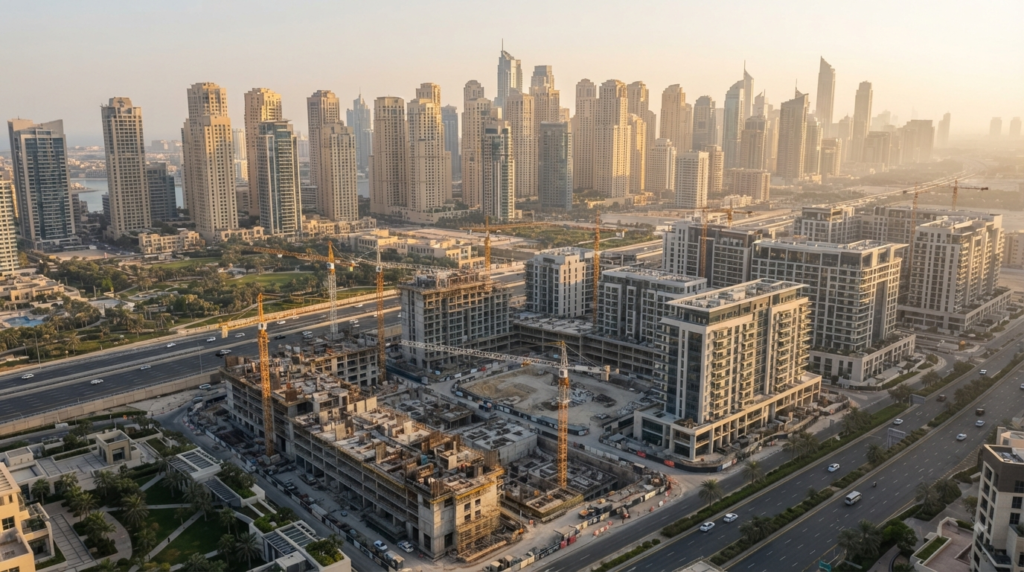
The disadvantages of buying property in Dubai start with a simple truth: no market is risk-free. Dubai has a strong regulatory infrastructure and delivered impressive returns over the past decade. It also has a documented history of market volatility, oversupply, and global sensitivity.
Understanding these risks is not a reason to avoid Dubai. It is a reason to enter it correctly.
Volatility History
Dubai’s property market has experienced two significant corrections in the past two decades. The 2008 global financial crisis triggered sharp price falls across all precincts. A second softer correction ran from 2015 to 2020 as oversupply accumulated.
Recovery in both cases was strong. According to Engel and Volkers, Dubai residential property prices grew by more than 80% from the 2020 market low through to late 2025. That recovery rewarded long-term holders and punished short-term speculators. One of the clearest disadvantages of buying property in Dubai is that it punishes impatience.
Oversupply Risk
With over 100,000 new residential units projected for delivery in 2026 alone, oversupply remains a structural concern in specific market segments. Mid-market and peripheral districts carry higher vacancy risk than established prime precincts.
Precincts like Downtown Dubai, Palm Jumeirah, and Dubai Marina have historically absorbed new supply without significant yield compression. Peripheral zones have not always done the same. Precinct selection is the most effective tool for managing oversupply risk as an investor.
Global Sensitivity
Dubai’s economy remains sensitive to global conditions. Oil price movements, regional geopolitical events, and global recessions all affect transaction volumes and property values. This sensitivity is one of the disadvantages of buying property in Dubai that purely domestic investors do not face.
The AED is pegged to the USD at 3.67, which eliminates currency volatility between the AED and the USD. However, Gold Coast investors still face AUD-USD exchange rate fluctuation on every transfer they make.
For Gold Coast investors already holding domestic property, Dubai adds a genuinely different risk profile to their portfolio. Diversification is the benefit. Understanding that a different risk profile is the obligation.
What Are Hidden Buying Costs?

The disadvantages of buying property in Dubai are most frequently underestimated in the cost column. Many Gold Coast investors focus on purchase price and yield projections but overlook the full transaction cost picture.
What we have consistently observed is that investors who budget accurately for all costs from day one avoid the frustration that catches others off guard post-purchase.
Transaction Fees
The Dubai Land Department charges a one-time 4% registration fee on every property transaction, regardless of nationality. On top of this, agency fees of approximately 2% apply to resale purchases. Combined, this puts total transaction costs at 6% to 8% of the purchase price before any mortgage fees or administrative charges.
On an AUD 550,000 investment property in Dubai Marina, total transaction costs beyond the purchase price reach approximately:
| Cost Item | Rate | AUD Estimate |
| DLD Registration Fee | 4% of the purchase price | AUD 22,000 |
| Agency Fee (resale) | 2% of purchase price | AUD 11,000 |
| Developer Admin Fee | AED 500 to AED 5,000 | AUD 210 to AUD 2,100 |
| Currency Transfer | 0.3% to 0.8% (specialist FX) | AUD 1,650 to AUD 4,400 |
| Mortgage Fees (if applicable) | 0.25% of loan + valuation | AUD 2,000 to AUD 4,000 |
| Total Additional Costs | AUD 36,860 to AUD 43,500 |
AUD figures based on the UAE Central Bank AED-USD peg of 3.67 and prevailing rates. Agency fee waived on direct developer purchases at the expo.
These costs are fixed and unavoidable on resale purchases. On direct off-plan developer purchases at the expo, the agency fee is typically waived, reducing total acquisition costs to approximately 4% to 5%.
Service Charges
Annual building service charges are one of the most frequently underestimated disadvantages of buying property in Dubai. These charges cover common area maintenance, security, facilities management, and building operations.
Service charges vary significantly by property type and location:
| Property Class | AED per Sq Ft per Year | Notes |
| Mid-market (JVC, Dubai South) | AED 10 to AED 25 | Lower amenity load |
| Premium (Dubai Marina, Business Bay) | AED 20 to AED 45 | Higher facilities cost |
| Waterfront (Palm Jumeirah) | AED 25 to AED 50+ | Specialised maintenance |
| Iconic towers (Downtown) | AED 60 to AED 80+ | World-class amenities load |
On a 700 square foot one-bedroom in Dubai Marina at AED 30 per square foot, annual service charges reach AED 21,000 (approximately AUD 8,820). This directly reduces net yield from the gross figure marketed by developers.
Ongoing Costs
Beyond service charges, Gold Coast investors holding Dubai property incur property management fees of 5% to 8% of gross annual rental income, currency transfer costs on every instalment and every rental receipt, and ATO income tax on all Dubai rental income at Australian marginal rates.
Visit ato.gov.au for full guidance on overseas rental income obligations. The net yield after all costs is the correct comparison figure, not the gross yield figure that developers advertise.
A full cost and SMSF structuring guide is available here: Buy Property in Dubai from Australia:
What Risks Do Foreigners Face?

The disadvantages of buying property in Dubai for foreign nationals specifically include legal restrictions that domestic buyers do not face. Understanding these before selecting a property prevents wasted time and misdirected capital.
From years of advising Gold Coast investors, the most common source of avoidable frustration is discovering ownership restrictions only after developing a strong interest in a specific property.
Freehold Zone Limits
Foreign nationals can only purchase property in designated freehold zones. Dubai has many excellent investment precincts outside these zones that are closed to non-UAE nationals. This limits foreign buyer options to specific areas, which affects location flexibility and can affect resale liquidity in some cases.
The major freehold zones covering Dubai Marina, Downtown Dubai, Business Bay, JVC, Palm Jumeirah, and Dubai South address the needs of most Gold Coast investors well. However, the restriction is a genuine constraint worth acknowledging.
For a full breakdown of freehold zone rights and ownership protections, read Dubai Freehold Properties for Foreigners: What Gold Coast Investors Must Know.
Off-Plan Delays
Construction delays remain one of the notable disadvantages of buying property in Dubai for off-plan purchasers. Tying up capital for 12 to 36 months with no rental income during construction is a cash flow consideration that all off-plan buyers must plan around.
RERA’s escrow account requirement has significantly reduced the financial risk of project cancellations. Buyer funds are held in government-supervised accounts and released only at verified construction milestones. However, timeline extensions still occur even with reputable developers. Always review the SPA’s penalty provisions for delays before signing.
Mortgage Restrictions
Non-resident foreign buyers face a maximum loan-to-value ratio of 50% to 60% from UAE banks. This compares to up to 80% LTV available to UAE residents. The higher down payment requirement means more capital tied up per property, reducing leverage efficiency for Gold Coast investors who rely on debt to build portfolios.
Most Gold Coast investors at the expo opt for developer payment plans rather than UAE bank mortgages. Payment plans are interest-free and require only 10% to 20% upfront, making them more capital-efficient than bank financing for most situations.
How Do Investors Manage Risk?

Knowing the disadvantages of buying property in Dubai is only useful if you act on that knowledge. The right approach to each risk type significantly changes investment outcomes.
The difference between informed and uninformed Dubai investors is almost entirely attributable to preparation and developer selection.
Developer Due Diligence
Developer quality is the single most effective tool for managing the disadvantages of buying property in Dubai related to off-plan risk. RERA-registered developers with multiple delivered projects, confirmed escrow accounts, and strong secondary resale markets on their completed work eliminate the majority of off-plan risks.
Key developer vetting steps:
- Confirm RERA registration at the Dubai Land Department
- Review the track record of on-time project delivery
- Verify escrow account registration for the specific project
- Read SPA penalty clauses for construction delays
- Assess secondary market depth for the developer’s completed stock
All developers at the Dubai Property Expo Gold Coast 2026 are pre-vetted by the Bright Realty International team before presentation.
Long-Term Strategy
The disadvantages of buying property in Dubai shrink significantly on a five to ten-year investment horizon. Market cycles, temporary oversupply, and short-term volatility all average out over longer hold periods. According to Knight Frank, Dubai’s prime precincts have delivered sustained appreciation over each five-year period since 2012.
Short-term speculation in Dubai property is high risk. Long-term holding in quality precincts with strong tenant demand has rewarded investors consistently. Gold Coast investors who enter with a clear exit strategy and a minimum five-year horizon are far better positioned than those seeking quick capital gains.
Choose Your Broker
Rogue brokers and social media influencers promoting unregulated or unsuitable Dubai property represent one of the more avoidable disadvantages of buying property in Dubai. Finding a RERA-licensed broker with verifiable transaction history requires deliberate vetting.
The most efficient route for Gold Coast investors is attending the Dubai Property Expo Gold Coast 2026 and working through the Bright Realty International team, who maintain direct relationships with all major RERA-registered developers. This eliminates intermediary risk entirely and provides access to developer-direct pricing and payment plans.
Invest Wisely from Gold Coast?
The disadvantages of buying property in Dubai are real but manageable with the right information, the right developer, and a long-term perspective. High transaction costs, market cycles, and ownership restrictions are genuine considerations. They are not reasons to avoid the market. There are reasons to enter it correctly.
The Dubai Property Expo Gold Coast 2026 gives you direct access to pre-vetted developers, honest investment advice, and the information you need to make a confident decision. Every project presented is RERA-registered, escrow-protected, and reviewed by the Bright Realty International team before reaching the expo floor.
Registration is completely free, and seats are limited. Take the first step toward a well-informed Dubai investment from the Gold Coast. Secure your free seat at the Dubai Property Expo Gold Coast 2026 today.
Frequently Asked Questions
Is buying property in Dubai a good investment in 2026?
For long-term investors with a five to ten-year horizon, Dubai property remains a strong investment despite its noted disadvantages. According to Knight Frank, Dubai was among the world’s top-performing residential markets from 2022 through 2025, with over 80% price growth from the 2020 low. The key distinction is strategy. Short-term speculation carries significant risk given market cyclicality and high transaction costs. Long-term holding in prime freehold precincts with strong tenant demand has consistently rewarded patient investors.
What are the transaction costs of buying property in Dubai?
The total upfront transaction costs when buying property in Dubai typically reach 6% to 8% of the purchase price. The Dubai Land Department charges a mandatory 4% registration fee on all transactions. A 2% agency fee applies to resale purchases, but is generally waived on direct developer purchases at expo events. Additional costs include developer admin fees, currency transfer costs, and mortgage registration fees if applicable. These costs reduce the net return from gross yield figures and must be factored into all investment calculations from the outset.
Can foreigners buy property anywhere in Dubai?
No. One of the clear disadvantages of buying property in Dubai for foreign nationals is that non-UAE nationals are restricted to purchasing in designated freehold zones only. These zones cover the city’s most popular investment precincts, including Dubai Marina, Downtown Dubai, Palm Jumeirah, Business Bay, JVC, and Dubai South. Properties outside these designated areas are available only to UAE and GCC nationals. Gold Coast investors should confirm freehold zone status before committing to any specific property or location.
What happens if a Dubai developer delays or cancels my project?
RERA requires all off-plan developer payments to be held in government-supervised escrow accounts. Funds are released to the developer only at verified construction milestones. If a project is formally cancelled, buyers are entitled to full refunds from the escrow account. Construction delays are more common and are addressed through penalty clauses in the Sales and Purchase Agreement. Always confirm that your project has a registered DLD escrow account and that the SPA contains clear penalty provisions before signing
Are service charges on Dubai property very high?
Service charges vary significantly by property type and location. Mid-market apartments in precincts like JVC and Dubai South carry charges of AED 10 to AED 25 per square foot annually. Premium developments in Dubai Marina and Business Bay range from AED 20 to AED 45 per square foot. Iconic towers in Downtown Dubai can reach AED 60 to AED 80 per square foot. In a 700 square foot one-bedroom apartment, mid-market service charges represent approximately AUD 2,940 to AUD 7,350 annually. Always request the full service charge schedule from the developer or building’s owner association before finalizing any purchase.