Quick Answer
- Invest in property in Dubai for gross rental yields of 6% to 12%, far above the Gold Coast average of 4% to 5%
- Dubai charges zero property tax, zero rental income tax, and zero capital gains tax
- Properties from AED 750,000 qualify for long-term residency; AED 2 million unlocks the 10-year Golden Visa
- Dubai’s population is targeted to grow from 4 million in 2025 to 5.8 million by 2040, driving structural housing demand
- The full purchase process can be completed remotely from the Gold Coast with no UAE travel required
Invest in property in Dubai for gross rental yields of 6% to 12%, zero property tax, and a structural population growth story that domestic Australian markets cannot replicate.
Since 2020, average Dubai property prices have increased by over 75%, and the IMF projects 5% UAE GDP growth in 2026 alone. For Gold Coast investors weighing where to deploy capital next, the Dubai case rests on three pillars: tax efficiency, yield, and a government-backed growth trajectory running through 2040.
This guide covers exactly why Gold Coast investors should invest in property in Dubai in 2026, the real numbers behind the opportunity, the step-by-step buying process, and how to manage risk along the way.
Why Invest in Property Dubai?
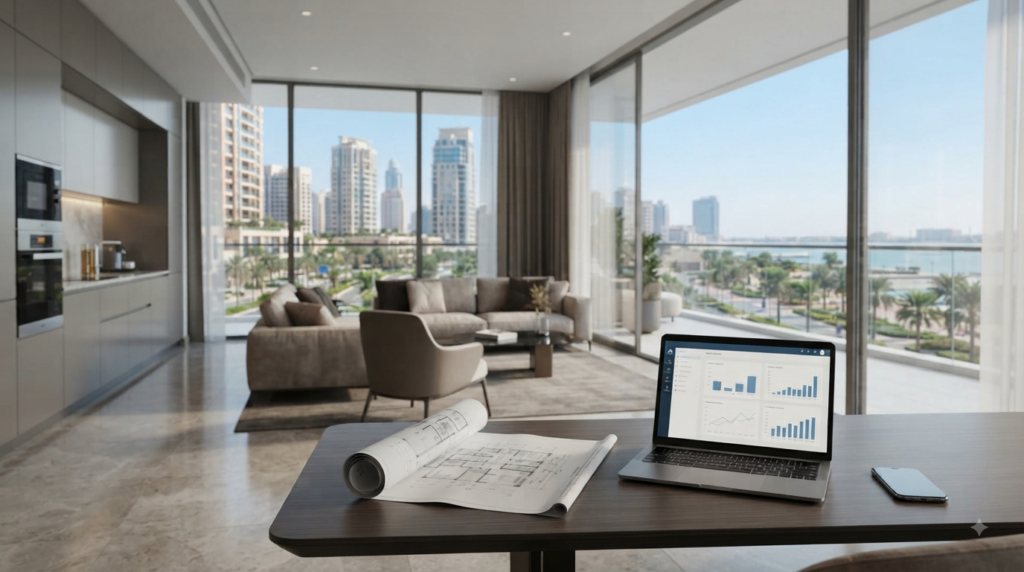
Invest in property in Dubai decisions consistently come down to a comparison most Gold Coast investors find compelling once they see the figures side by side. Dubai delivers structural advantages that compound over a multi-year hold.
Tax-Free Returns
Dubai charges no annual property tax, no rental income tax, and no capital gains tax. This stands in sharp contrast to Australian land tax, which compounds as a Gold Coast portfolio grows across multiple properties.
According to Dubai Land Department transaction records, this tax-free structure has been a consistent driver of foreign capital inflow since freehold ownership was introduced for non-UAE nationals in 2002.
High Rental Yields
Average gross rental yields across Dubai sit at approximately 7%, significantly higher than many comparable global cities. According to CoreLogic, Gold Coast residential investment property delivers gross yields of only 4% to 5% in 2026.
Prime mid-market precincts like JVC and Dubai Silicon Oasis regularly deliver 6% to 10% gross yields. As a result, the net yield gap after Australian land tax and holding costs widens even further in Dubai’s favour.
Growth & Visa Benefits
Since 2020, property in Dubai, the average prices have increased by over 75%, reflecting sustained demand from a rapidly growing population. The UAE government targets growing Dubai’s population from approximately 4 million in 2025 to 5.8 million by 2040.
Investors who invest in property in Dubai above AED 750,000 qualify for long-term UAE residency. Properties above AED 2 million unlock the ten-year renewable Golden Visa, extending to spouse and dependent children with no local sponsor required.
What Property Types Qualify?
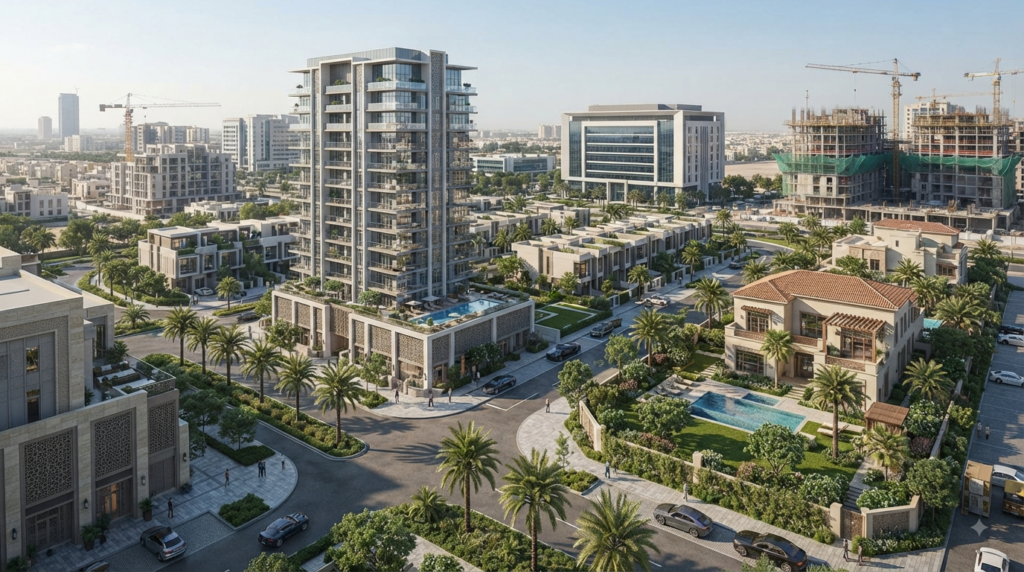
Choosing the right property type when you invest in property in Dubai shapes both your income timeline and your capital growth profile. Each category suits a different Gold Coast investor objective.
Understanding the trade-offs between off-plan and ready stock is the most important early decision in the process.
Residential vs Commercial
Residential properties, including apartments, townhouses, and villas, are the most popular choice for Gold Coast investors. They offer stable rental demand and long-term capital appreciation supported by Dubai’s growing expatriate population.
Commercial property in Dubai, including offices and retail units, can deliver high yields on long-term lease contracts. However, the dynamics differ significantly from residential, and specialist advice is recommended before entering this segment.
Off-Plan vs Ready
Off-plan properties are priced lower than comparable ready stock, offering stronger potential capital appreciation upon completion. Payments are held in RERA-supervised escrow accounts and released only at verified construction milestones, protecting buyer funds throughout the build.
Ready properties generate rental income immediately and suit Gold Coast investors prioritising day-one cash flow. They are also typically the preferred choice for buyers using mortgage finance rather than developer payment plans.
Freehold Zone Rules
Foreign nationals, including Australian citizens, can purchase property in Dubai only within designated freehold zones. These zones grant full ownership rights, registered permanently with the Dubai Land Department, with no restrictions on selling, leasing, or inheriting.
For a complete breakdown of which precincts qualify and what they deliver, read Dubai Freehold Properties for Foreigners: What Gold Coast Investors Must Know.
How Do You Buy Property?

The process to invest in property in Dubai follows a clear, structured sequence. Most Gold Coast investors complete the entire transaction remotely from Queensland without travelling to the UAE.
Knowing each stage in advance prevents delays and avoids the common mistakes first-time buyers make.
Purchase Steps
After selecting a property, an Expression of Interest may be submitted on new launches with limited availability. For existing inventory, a reservation deposit of 10% to 20% secures the unit directly.
A booking form is signed first, confirming the unit, price, and payment plan. The formal Sales and Purchase Agreement follows, setting out all legal and financial terms including the payment structure and expected completion date.
Costs to Budget For
Beyond the purchase price, the Dubai Land Department charges a 4% registration fee, comparable to transfer tax in other markets. Annual service charges cover building maintenance and shared facilities.
| Cost Item | Rate | AUD Estimate (AUD 300K Purchase) |
| DLD Registration Fee | 4% of purchase price | AUD 12,000 |
| Agency Fee (resale) | 2% of purchase price | AUD 6,000 |
| Currency Transfer | 0.3% to 0.8% via specialist FX | AUD 900 to AUD 2,400 |
| Annual Service Charge | AED 10 to AED 25 per sq ft | AUD 1,500 to AUD 3,800 |
AUD figures based on UAE Central Bank AED-USD peg of 3.67 and prevailing rates. Confirm exact costs at the expo.
Buying From Abroad
The entire process can be managed remotely. Contracts are signed digitally, and payments are made via international transfer, with power of attorney used in some cases.
This significantly lowers the barrier to entry for Gold Coast investors, since physical presence in the UAE is not required at any stage. The full step-by-step process is covered here: How to Buy Property in Dubai from Australia: Step-by-Step Guide (2026).
What Returns Can Investors Expect?
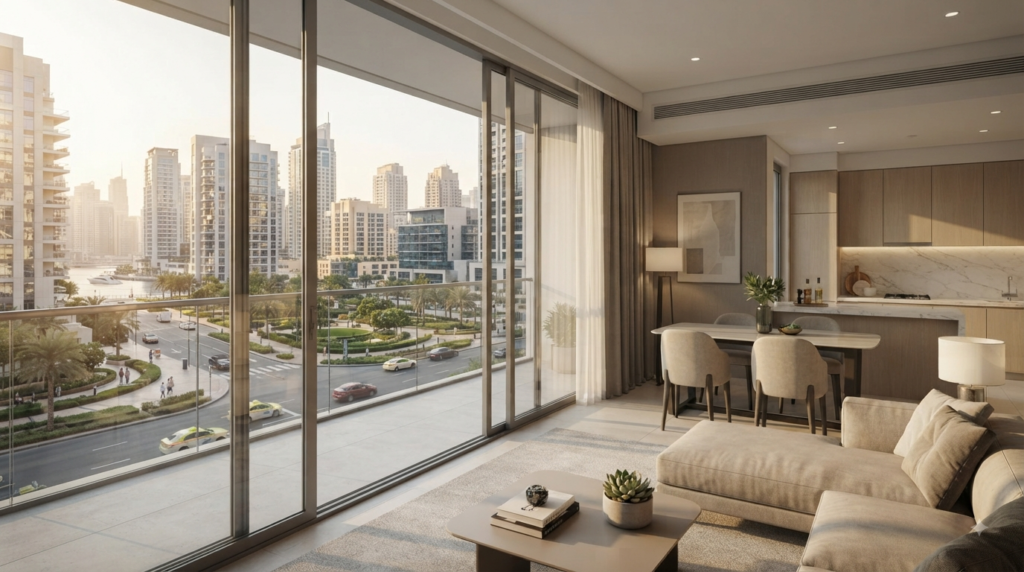
Returns when you invest in property in Dubai vary meaningfully by location, property type, and rental strategy. Realistic expectations matter more than chasing the highest headline yield figure.
A well-informed Gold Coast investor weighs yield alongside risk, location quality, and long-term demand fundamentals.
Yield by Precinct
JVC and Dubai Silicon Oasis regularly deliver gross yields of 6% to 10%. Studios and one-bedroom apartments perform strongest, driven by broad rental demand from Dubai’s large expatriate workforce.
Larger properties tend to suit personal use or specific target groups rather than maximum yield. This distinction has a direct impact on overall income stability and should shape your property selection from the outset.
Capital Growth Potential
For off-plan properties, capital appreciation can reach 5% to 10% annually according to industry analysts cited by Forbes. From construction start to handover, values have increased 15% to 30% in many projects, with some precincts seeing growth of 50% to 100% under strong demand conditions.
According to Knight Frank, premium Dubai precincts continue to outperform many comparable global cities on sustained price growth.
Rental Strategy Comparison
Long-term rentals suit expatriate professionals working in Dubai and deliver predictable, lower-management income. Short-term rentals cater to tourism and business travel and can generate higher returns in the right locations, but require a permit and active daily management.
For full precinct-by-precinct yield data, read Property for Rent in Dubai: Gold Coast Investor Yield Guide 2026.
What Risks Should Investors Know?
Every decision to invest in property in Dubai should be made with full awareness of the genuine risks involved. Informed investors consistently outperform those acting on yield headlines alone. Acknowledging these risks upfront is what separates a confident long-term strategy from a reactive purchase.
Market Volatility
Like any real estate market, Dubai experiences price and demand fluctuations. A long-term outlook and realistic expectations around valuation changes are essential for sustained investment success.
History shows that short-term speculation carries more risk than holding through a full market cycle. Gold Coast investors with a five- to ten-year horizon are best positioned to ride out short-term volatility.
Regulatory Changes
Dubai maintains a well-defined legal framework, but regulations can evolve over time. Staying informed about RERA and Dubai Land Department updates ensures continued compliance and protects your investment position.
Working with a reputable, RERA-registered developer significantly reduces exposure to this risk category. All projects at the Dubai Property Expo Gold Coast 2026 are pre-vetted accordingly.
Common Buyer Mistakes
Many investors place too much emphasis on entry price alone. A lower purchase price says little about an investment’s long-term quality, while location and rental demand are far more decisive for stable returns.
Service charges are also frequently underestimated. Always request the full annual charge schedule before committing, and factor it directly into your net yield calculation from day one.
Understanding these risks allows investors to plan more effectively and make better long-term decisions. With the right preparation and professional guidance, most investment risks can be managed successfully.
Invest Confidently from Gold Coast
Invest in Dubai property decisions reward Gold Coast investors who understand the full picture: tax-free returns, yields of 6% to 12%, and a population growth story backed by government infrastructure planning through 2040. The combination of structural demand and zero local tax creates conditions the Australian market simply cannot replicate.
The Dubai Property Expo Gold Coast 2026 is the most efficient way to act on this opportunity. Meet RERA-registered developers, compare live projects across every major precinct, and get every financial and legal question answered by specialists who understand the Australian investor’s perspective.
Registration is completely free, and seats are limited. Take the first step toward a tax-efficient, high-yield Dubai portfolio without leaving Queensland. Register free at the Dubai Property Expo Gold Coast 2026 today.
Frequently Asked Questions
Why should I invest in property in Dubai over local options?
Invest in property in Dubai decisions consistently outperform Gold Coast alternatives on yield and tax efficiency. Dubai delivers gross rental yields of 6% to 12%, compared to the Gold Coast average of 4% to 5%, according to CoreLogic. Dubai also charges zero property tax, zero rental income tax, and zero capital gains tax, unlike Queensland’s land tax structure. Combined with structural population growth targeting 5.8 million residents by 2040, the long-term demand fundamentals support a stronger investment case than most domestic alternatives currently offer.
How much do I need to invest in property in Dubai?
Entry-level apartments in Dubai’s mid-market precincts start from approximately AUD 200,000, subject to developer confirmation at the expo. With developer payment plans requiring only 10% to 20% upfront, the initial capital outlay can be as low as AUD 20,000 to AUD 40,000. Properties above AED 750,000 (approximately AUD 315,000) qualify for long-term UAE residency, while AED 2 million (approximately AUD 840,000) unlocks the ten-year Golden Visa for the investor and their family.
Can Gold Coast investors buy Dubai property remotely?
Yes. The entire process to invest in property in Dubai can be completed from Queensland without travelling to the UAE. Contracts are signed digitally, payments are made via international bank transfer, and power of attorney can be used where needed. The Bright Realty International team manages the full process remotely, from initial project selection through to Dubai Land Department title registration and ongoing property management coordination.
What yields can I realistically expect from Dubai property?
Average gross rental yields across Dubai sit at approximately 7%, with prime mid-market precincts like JVC and Dubai Silicon Oasis regularly delivering 6% to 10%. Studios and one-bedroom apartments typically perform strongest due to broad expatriate rental demand. Returns vary by location, property type, and rental strategy, so realistic expectations grounded in specific precinct data consistently outperform decisions based on headline yield figures alone.
Is it still a good time to invest in property in Dubai in 2026?
Yes, for investors with a long-term perspective. Since 2020, average Dubai investment property prices have increased by over 75%, and the IMF projects 5% UAE GDP growth in 2026. Dubai’s population is targeted to grow from 4 million to 5.8 million by 2040, creating sustained structural housing demand rather than short-term speculative growth. Gold Coast investors who enter with a five- to ten-year horizon and a clear strategy are well positioned to benefit from this continued trajectory.