Quick Answer
- Dubai property prices average AED 1,692 per square foot (AUD 711 per sq ft) across all residential zones in 2026
- JVC offers the most accessible investor entry at AED 1,473 per sq ft (AUD 619), with yields of 8% to 9.6%
- Business Bay and Dubai Marina average AED 2,058 to AED 2,547 per sq ft for premium yield and capital growth
- Palm Jumeirah tops Dubai property prices at AED 4,000 per sq ft, with Golden Visa qualifying properties available
- Dubai property prices rose 18% year on year from January 2025 to January 2026 per Dubai Land Department data
Dubai property prices range from AED 750 per square foot in International City to over AED 4,000 per square foot on Palm Jumeirah, a price spectrum wider than any comparable global city. For Gold Coast investors evaluating where to deploy capital, understanding which price band delivers the strongest net return changes the entire investment decision.
The challenge is that most overseas property guides either oversimplify Dubai into a single market or drown investors in data without a clear investment lens. Gold Coast investors need specific area-by-area pricing, AUD equivalents, and honest yield context, not generic market overviews.
This guide breaks Dubai property prices down by precinct, translates every figure into AUD, compares the investment case for affordable versus premium zones, and covers the full cost picture for Queensland buyers in 2026.
How Much Does Dubai Cost?
Dubai property prices across all residential transactions averaged at AED 1,692 per square foot in early 2026, based on 192,808 transactions recorded from January 2025 onward, with apartments averaging AED 1,729 per sq ft and villas AED 1,468 per sq ft.
Citywide Price Overview
The market-wide average Dubai property price per square foot stood at approximately AED 1,976 in January 2026, an 18% year-on-year increase from January 2025’s average of AED 1,674 per sq ft. This figure reflects the weighted average across all transaction types, from affordable mid-market apartments to ultra-luxury waterfront villas.
For Gold Coast investors, the more relevant benchmark is the investable median rather than the luxury-skewed average. The typical investment apartment in Dubai transacts at approximately AED 1.3 million (AUD 546,000), while the typical villa sits at approximately AED 3.6 million (AUD 1,512,000), according to Dubai Land Department data.
The entry-level to premium spread in Dubai property prices means Gold Coast investors at any budget level can find a qualifying freehold asset within the market, a flexibility that does not exist in the Gold Coast’s own compressed price band.
Price Growth Trends
Dubai residential property prices have compounded at 11.7% CAGR from 2020 to 2026, with prices nearly doubling from the 2020 trough, though the year-on-year growth rate has moderated from a 2022 peak of 26.9% to a more sustainable 8.8% in 2025.
This moderation is a positive signal for Gold Coast investors evaluating entry timing. A market growing at 8% to 10% per year is more sustainable than one rising at 27%, and the DLD’s full-year 2025 result of 215,060 sales worth AED 682.6 billion confirms that volume and value are growing in parallel rather than diverging.
The growth trend in Dubai property prices over six years means investors who bought in 2020 have seen capital gains of approximately 91%, according to Engel and Volkers Dubai. Long-horizon Gold Coast investors entering in 2026 are buying into a maturing market with established infrastructure, not speculative early-stage growth.
Off-Plan vs Ready
Off-plan and new-build homes in Dubai usually cost about 10% to 18% more than similar older ready homes. This premium reflects the combination of modern specifications, developer payment plan benefits, and capital appreciation potential between purchase and handover.
Ready properties suit Gold Coast investors who want immediate rental income without a construction wait. Off-plan suits investors comfortable with a 12 to 36-month horizon who want:
- Lower effective entry price at launch versus current secondary market value
- Interest-free staged payment plans requiring only 10% to 20% upfront
- Potential capital appreciation between purchase date and handover
- RERA-supervised escrow protection throughout the construction period
For the complete step-by-step buying process from Queensland, read How to Buy Property in Dubai from Australia: Step-by-Step Guide (2026).
Both categories present strong opportunities within Dubai property prices in 2026. The right choice depends on your income timeline and capital efficiency requirements. Investors prioritising immediate cash flow choose ready property. Investors prioritising capital efficiency and maximum payment plan flexibility choose off-plan. This section has established the citywide pricing baseline and growth context. The next step is examining which areas deliver the strongest investment value at accessible price points for Gold Coast buyers.
Which Areas Are Affordable?
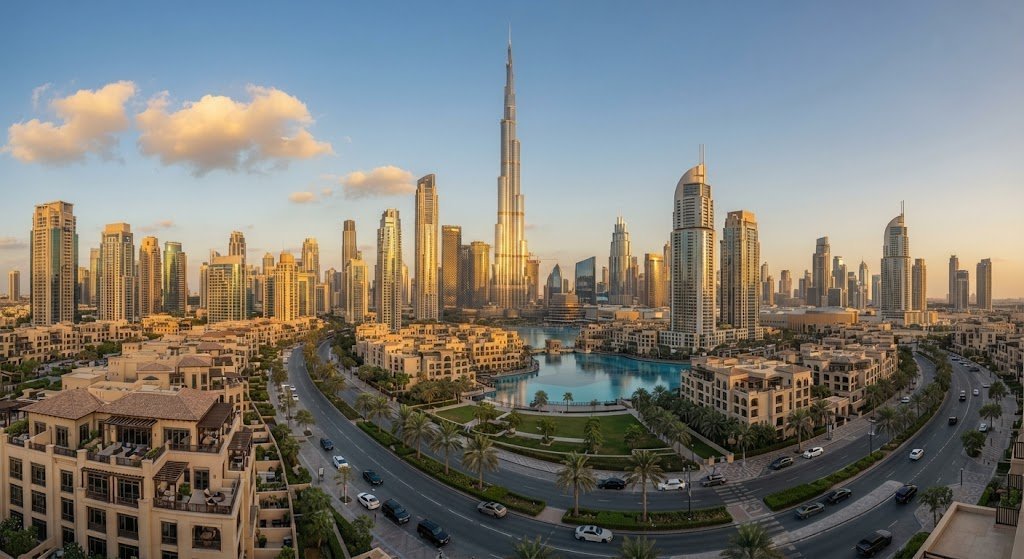
The most accessible Dubai property prices for Gold Coast investors concentrate in three precincts that combine low entry cost with the strongest gross rental yields in the city. Each area serves a different segment of Dubai’s large mid-income expatriate tenant base.
JVC and Arjan
Jumeirah Village Circle is the most popular affordable precinct for yield-focused Gold Coast investors. JVC recorded 1,072 transactions in January 2026 at an average of AED 1,473 per sq ft, one of the highest transaction volumes in Dubai, confirming deep liquidity alongside accessible pricing.
Arjan, adjacent to JVC, offers similar price dynamics with a slightly lower average and a growing retail and transport infrastructure profile. Studios in JVC start from approximately AED 700,000 (AUD 294,000) and one-bedroom apartments from approximately AED 900,000 (AUD 378,000), subject to developer confirmation at the expo.
Dubai property prices in JVC support gross rental yields of 8.8% to 9.6% on apartments, the strongest income profile of any well-established Dubai precinct, according to Dubai Land Department rental transaction data.
Dubai South Prices
Dubai South currently offers the most compelling growth-yield combination among affordable Dubai precincts. Average Dubai property prices per square foot here sit between AED 1,200 and AED 1,400, with studios from approximately AED 600,000 (AUD 252,000) and one-bedroom apartments from approximately AED 800,000 (AUD 336,000).
One-bedroom apartments deliver gross yields of 9.4% in Dubai South, slightly above JVC at this configuration. The capital growth case here rests on the Al Maktoum International Airport expansion, which is progressing and is projected to become the world’s largest aviation hub, creating structural residential demand in the surrounding precinct over a five to ten year horizon.
Dubai South suits Gold Coast investors who want entry-level Dubai property prices combined with a long-term capital growth story that JVC and established precincts cannot match at current pricing.
International City
International City represents the absolute floor of Dubai property prices in 2026. The price gap between Dubai’s cheapest and most expensive neighbourhoods is dramatic: International City averages AED 750 per sq ft while Palm Jumeirah can exceed AED 6,000 per sq ft.
Studio apartments here are available from approximately AED 450,000 to AED 550,000 (AUD 189,000 to AUD 231,000), with gross rental yields of 8% to 10.5% driven by a broad mid-income tenant base.
| Affordable Precinct | AED/sq ft | AUD/sq ft | Studio Entry (AED) | AUD Equiv | Gross Yield |
| International City | AED 750-1,050 | AUD 315-441 | AED 450,000 | AUD 189,000 | 8%-10.5% |
| Dubai South | AED 1,200-1,400 | AUD 504-588 | AED 600,000 | AUD 252,000 | 8.9%-9.4% |
| JVC | AED 1,473 | AUD 619 | AED 700,000 | AUD 294,000 | 8.8%-9.6% |
| Arjan | AED 1,400-1,600 | AUD 588-672 | AED 650,000 | AUD 273,000 | 7.5%-8.5% |
These affordable precincts give Gold Coast investors access to Dubai property prices and gross yields that are genuinely impossible to replicate domestically. For context, CoreLogic data confirms Gold Coast units average AUD 795,000 to AUD 987,000 in 2026, with gross yields of 4.1% to 5.3% for apartments. Dubai’s affordable segment delivers more than double the income at less than half the entry price. For full rental yield data by precinct, read Property for Rent in Dubai: Gold Coast Investor Yield Guide 2026.
The affordable precinct comparison shows clearly that Dubai property prices at the entry level create a fundamentally different investment equation from the Gold Coast. Understanding premium pricing is equally important for investors with higher capital allocations or Golden Visa ambitions.
What Are Premium Areas?
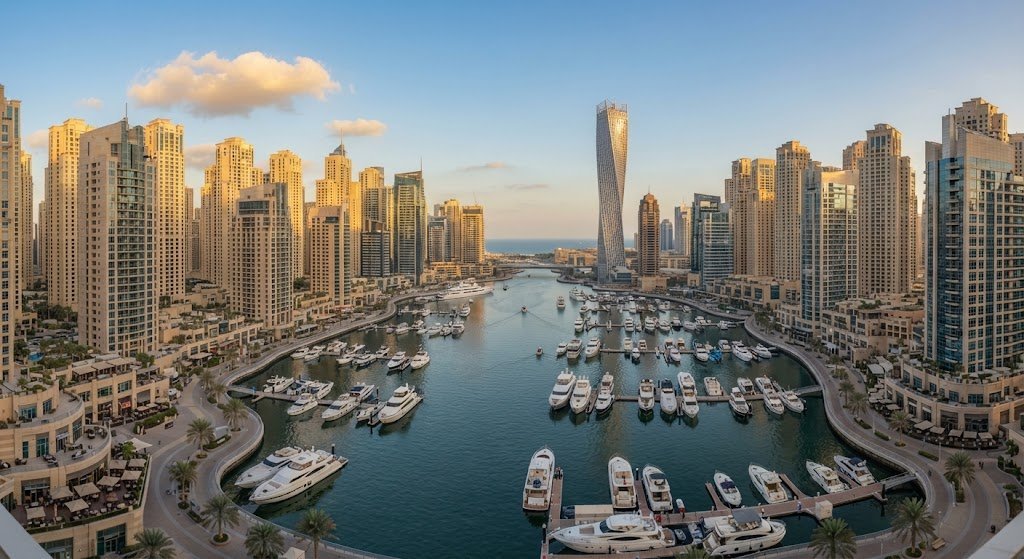
Premium Dubai property prices sit in precincts where global tenant demand, landmark infrastructure, and established brand recognition support both strong yield and sustained capital appreciation. For Gold Coast investors with larger capital allocations or Golden Visa ambitions, these precincts deserve close examination.
Dubai Marina Prices
The average price per square foot in Dubai Marina is AED 2,058/sq ft as of June 2026, based on DLD transaction data. One-bedroom apartments average AED 1.8 million (AUD 756,000) and two-bedroom apartments range from AED 2.5 million to AED 3 million (AUD 1,050,000 to AUD 1,260,000).
Dubai Marina Dubai property prices deliver gross rental yields of 6.5% to 8% for well-managed apartments, driven by strong expatriate professional demand and year-round tourism. The precinct offers the deepest secondary market liquidity in Dubai, meaning exits are faster and more reliable than in almost any other freehold zone.
For Gold Coast investors who want a premium asset with strong exit flexibility alongside solid income, Dubai Marina is the benchmark balanced choice.
Business Bay Overview
The average price per square foot in Business Bay is AED 2,547/sq ft, making it the highest-priced precinct among the major mid-premium investment zones. This premium reflects its proximity to Downtown Dubai, the DIFC financial district, and consistent demand from corporate professionals and executives.
One-bedroom apartments in Business Bay average approximately AED 1.4 million (AUD 588,000). Gross rental yields here run 6% to 7%, with a tenant profile that means longer tenancies, lower vacancy, and less management complexity than more transient precincts.
Dubai property prices in Business Bay suit Gold Coast investors who prioritise professional tenant quality and management simplicity over maximum gross yield numbers.
Downtown and Palm
Downtown Dubai and Palm Jumeirah sit at the top of Dubai property prices in 2026. Palm Jumeirah leads Dubai property pricing at nearly AED 4,000 per sq ft, with two-bedroom apartments averaging AED 3.5 million to AED 5 million (AUD 1,470,000 to AUD 2,100,000).
Downtown Dubai one-bedroom apartments average approximately AED 2.3 million (AUD 966,000) and are well above the AED 2 million Golden Visa threshold. Both precincts are the natural home for Gold Coast investors seeking UAE Golden Visa eligibility alongside capital growth assets with global brand recognition.
| Premium Precinct | AED/sq ft | AUD/sq ft | 1BR Entry (AED) | AUD Equiv | Gross Yield |
| Dubai Marina | AED 2,058 | AUD 864 | AED 1,800,000 | AUD 756,000 | 6.5%-8% |
| Business Bay | AED 2,547 | AUD 1,070 | AED 1,400,000 | AUD 588,000 | 6%-7% |
| Downtown Dubai | AED 3,100 | AUD 1,302 | AED 2,300,000 | AUD 966,000 | 5%-7% |
| Palm Jumeirah | AED 4,000+ | AUD 1,680+ | AED 3,500,000+ | AUD 1,470,000+ | 5%-7% |
Premium Dubai property prices serve different investor objectives than affordable entry-level stock. They suit Gold Coast investors with larger capital allocations who want capital appreciation, Golden Visa eligibility, and globally liquid assets alongside income. For full ownership rights and freehold zone legal protections, read Dubai Freehold Properties for Foreigners: What Gold Coast Investors Must Know.
The key takeaway from premium versus affordable zone comparison is that Dubai property prices across both segments consistently outperform Gold Coast equivalents on net yield. The premium segment competes more directly with Gold Coast pricing but still delivers superior income due to zero local property tax. The affordable segment delivers superior income at far lower capital deployment. The choice between them depends on the investor’s return priority and capital budget.
What Do Investors Pay?
Beyond Dubai property prices per square foot, Gold Coast investors must account for a clear set of additional costs before calculating net return. These costs are fixed, predictable, and comparable to Australian purchasing costs.
Upfront Costs
Every Dubai property transaction incurs a 4% Dubai Land Department registration fee regardless of buyer nationality. This is the single largest additional cost and must be included in every calculation.
Key upfront costs beyond the Dubai property prices advertised:
- DLD registration fee: 4% of purchase price (mandatory, all buyers)
- Developer admin fee: AED 500 to AED 5,000 depending on developer
- Agency fee on resale: 2% of purchase price (waived on direct developer purchases)
- Mortgage registration fee: 0.25% of loan value if financing applies
On an AED 900,000 JVC one-bedroom purchase (AUD 378,000), the DLD fee alone adds AUD 15,120. Gold Coast investors should budget total acquisition costs at 5% to 7% above purchase price, depending on whether financing or direct developer purchase is used.
Currency Considerations
Every payment from a Gold Coast bank account converts AUD to AED. The AED is pegged to the USD at 3.67, eliminating AED-USD volatility. Your only currency variable is the AUD-USD exchange rate.
Using a specialist FX provider like OFX or Wise consistently saves 1% to 2% per transfer compared to standard Australian bank exchange rate margins. On total purchases of AUD 378,000 to AUD 756,000 spread across multiple installments, that saving is meaningful across the full payment schedule.
Gold Coast investors should set up their specialist FX account before making their first reservation deposit, not after receiving the first payment notice.
Net Return Calculation
The net return from any Dubai investment property requires accounting for all holding costs against gross rental income. All Dubai rental income must also be declared to the ATO at the investor’s Australian marginal rate.
| Cost Category | Rate | Annual AUD Cost (AUD 378K JVC 1BR) |
| Property Management | 5%-8% of gross annual rent | AUD 1,650 to AUD 2,640 |
| Service Charge | AED 12-18/sq ft (JVC typical) | AUD 1,764 to AUD 2,646 |
| Currency Transfer (rent) | 0.3%-0.8% per transfer | AUD 198 to AUD 528 |
| ATO Income Tax | Australian marginal rate | Varies |
| Land Tax | Zero in UAE | AUD 0 |
| Council Rates | No equivalent | AUD 0 |
| Net Yield Estimate | After fees (pre-ATO) | 6.5%-7.5% |
For the complete SMSF and finance structuring options, read Buy Property in Dubai from Australia: The Complete 2026 Finance Guide.
The net return calculation demonstrates that even after all operational costs, Dubai property prices in affordable precincts deliver net yields of 6.5% to 7.5%, far above any comparable Gold Coast investment property net return in 2026. The advantage compounds over time as land tax on domestic portfolios grows while Dubai’s zero-tax structure remains fixed.
Invest from Gold Coast Today
Dubai property prices across every area in 2026 present Gold Coast investors with a clear opportunity: stronger yields, lower entry points, zero local holding tax, and a government-regulated freehold ownership framework that has matured over 20+ years. Whether targeting JVC studios at AED 700,000 or Dubai Marina one-bedrooms at AED 1.8 million, the net return consistently outperforms the Gold Coast equivalent.
The Dubai Property Expo Gold Coast 2026 is your direct access point to developers across every precinct covered in this guide. Every project is pre-vetted, RERA-registered, and presented with confirmed pricing, current payment plans, and DLD transaction data.
Registration is completely free and seats are filling fast. Secure your free seat at the Dubai Property Expo Gold Coast 2026 today.
Frequently Asked Questions
What is the average price per sq ft in Dubai in 2026?
The median residential price per square foot in Dubai is approximately AED 1,692 in early 2026, based on 192,808 DLD transactions, with apartments averaging AED 1,729 per sq ft and villas AED 1,468 per sq ft. This translates to approximately AUD 711 per sq ft at current exchange rates, well below comparable Gold Coast waterfront or investment-grade suburban property on a per-square-foot basis.
Which area has the cheapest property prices in Dubai?
International City has the lowest average Dubai property prices at AED 750 to AED 1,050 per sq ft, with studios available from approximately AED 450,000 (AUD 189,000). JVC and Dubai South offer the next most accessible price points for Gold Coast investors wanting established yield alongside slightly higher build quality and precinct maturity.
Are Dubai property prices rising or falling in 2026?
Dubai property prices rose 18% year on year from January 2025 to January 2026, with the full year 2025 closing at record highs of 215,060 sales worth AED 682.6 billion. Growth is moderating from the 2022 peak of 26.9% annually to a more sustainable 8% to 10% range, suggesting a maturing market rather than an overheated one.
How do Dubai property prices compare to the Gold Coast?
Gold Coast units average AUD 795,000 to AUD 987,000 with gross yields of 4.1% to 5.3% according to CoreLogic, while comparable Dubai investment apartments in JVC start from AUD 294,000 with gross yields of 8.8% to 9.6%. Dubai property prices at the investment level are 50% to 70% lower than Gold Coast equivalents while delivering double the gross rental income.
Is it worth buying Dubai property at current 2026 prices?
For long-term investors with a five-plus year horizon, Dubai property prices in 2026 remain well-supported by structural demand from population growth targeting 5.8 million residents by 2040, zero annual property tax, and gross yields that significantly outperform any major comparable global market. The CAGR of 11.7% from 2020 to 2026 demonstrates sustained long-term value creation across the full market cycle.