Quick Answer
- The average house price in Dubai is approximately AED 1.7 million (AUD 714,000) as of mid-2026
- Dubai studios start from AED 700,000 (AUD 294,000), far below any comparable Gold Coast property today
- Gold Coast median house price reached approximately AUD 1.35 million in early 2026, up 10% year on year
- Dubai delivers gross rental yields of 6% to 8% versus the Gold Coast average of 2.8% to 4.1% for houses
- Investors in Dubai pay zero property tax while Gold Coast investors pay Queensland land tax on portfolios
The average house price in Dubai sits at approximately AED 1.7 million (AUD 714,000) in 2026, while the Gold Coast median house price has climbed to approximately AUD 1.35 million. On the surface the gap looks narrow. Dig into yields, entry costs, and tax treatment, and the picture shifts dramatically in Dubai’s favor.
For Gold Coast investors squeezed by rising land tax, softening net yields, and an entry price floor that has pushed most quality investment stock past AUD 1.2 million, Dubai is not simply a curiosity. It is a mathematically superior income asset available at a lower entry price with zero annual holding tax.
This guide covers every number Gold Coast investors need to make a fully informed comparison: average house prices in Dubai by property type and precinct, side-by-side market comparisons, yield and cost breakdowns, and exactly how to buy remotely from Queensland in 2026.
What Are Dubai House Prices?
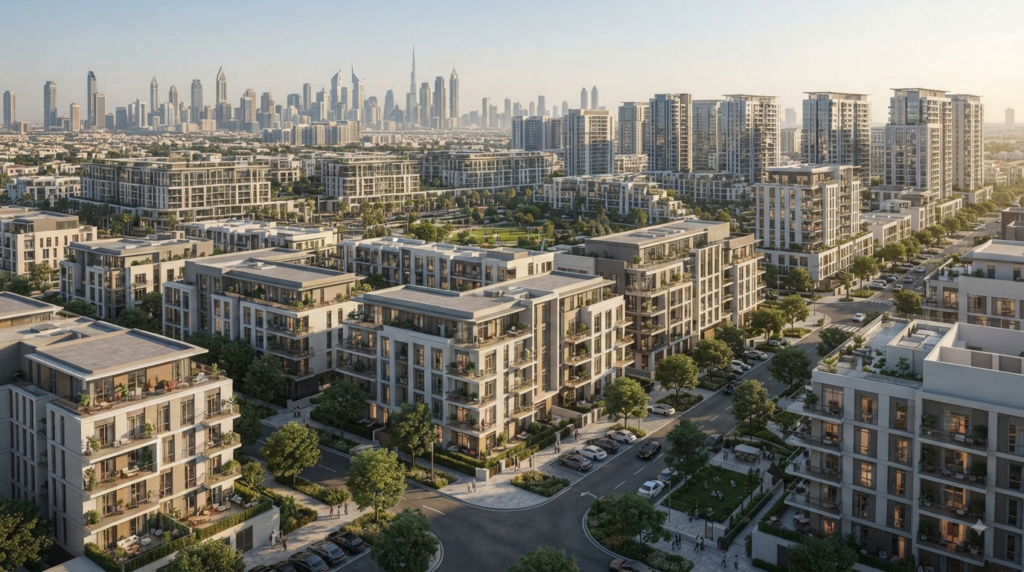
The average house price in Dubai across all residential property in 2026 sits at approximately AED 3.05 million, or around AUD 1.28 million at current exchange rates, though the median property price sits closer to AED 1.55 million. The gap between average and median reflects a top-heavy luxury segment pulling the average upward.
Overall Price Levels
As of June 2026, the citywide average price per square foot in Dubai is approximately AED 1,916, rising approximately 90% from the AED 872 per square foot average recorded in 2020. That trajectory reflects sustained demand from an expanding expatriate population and limited freehold supply in premium precincts.
For Gold Coast investors comparing this to domestic figures, the data from CoreLogic shows the Gold Coast median house price sitting around AUD 1.17 million in early 2026, up approximately 10% to 12% over the past year. The citywide Dubai average is therefore lower than the Gold Coast median once you exclude the ultra-luxury Dubai segment.
Prices by Type
Dubai’s residential market covers a wide price range depending on property type. Here is the full breakdown of average prices in AED and AUD equivalents.
| Property Type | Average AED Price | AUD Equivalent | Notes |
| Studio Apartment | AED 700,000 | AUD 294,000 | Highest gross yield, broadest demand |
| 1-Bedroom Apartment | AED 1,150,000 | AUD 483,000 | Most popular investor choice |
| 2-Bedroom Apartment | AED 2,000,000 | AUD 840,000 | Golden Visa threshold eligible |
| Townhouse | AED 3,000,000 | AUD 1,260,000 | Family tenant demographic |
| Villa | AED 4,800,000 | AUD 2,016,000 | Premium capital growth |
Entry-level studio and one-bedroom apartments represent the strongest value proposition for Gold Coast investors, comparing the average house price in Dubai against the AUD 1.35 million median required to enter the domestic Gold Coast market.
Price per Precinct
Price per square foot varies significantly across Dubai’s freehold zones. JVC one-bedroom apartments average AED 900,000 while Dubai Marina one-bedroom units average AED 1.8 million and Downtown Dubai one-bedroom apartments average approximately AED 2.3 million in 2026.
| Dubai Precinct | Avg AED/Sq Ft | AUD/Sq Ft | Avg 1BR Price (AED) | AUD Equivalent |
| Dubai South | AED 1,200 | AUD 504 | AED 850,000 | AUD 357,000 |
| JVC | AED 1,510 | AUD 634 | AED 900,000 | AUD 378,000 |
| Business Bay | AED 1,900 | AUD 798 | AED 1,400,000 | AUD 588,000 |
| Dubai Marina | AED 2,300 | AUD 966 | AED 1,800,000 | AUD 756,000 |
| Downtown Dubai | AED 3,100 | AUD 1,302 | AED 2,300,000 | AUD 966,000 |
| Palm Jumeirah | AED 4,240+ | AUD 1,781+ | AED 3,500,000+ | AUD 1,470,000+ |
Understanding precinct price ranges is essential before comparing the average house price in Dubai to Gold Coast alternatives. JVC and Dubai South offer investment-grade apartments at AUD 294,000 to AUD 378,000, which is the entry point that changes the entire investment calculation for Queensland buyers.
The precinct data reveals a clear pattern: mid-market Dubai precincts deliver far lower entry prices than Gold Coast equivalents while delivering far higher gross yields. That combination sits at the core of why more Gold Coast investors are exploring Dubai in 2026. For the full ownership rights guide across freehold zones, read Dubai Freehold Properties for Foreigners: What Gold Coast Investors Must Know.
Gold Coast vs Dubai Prices?
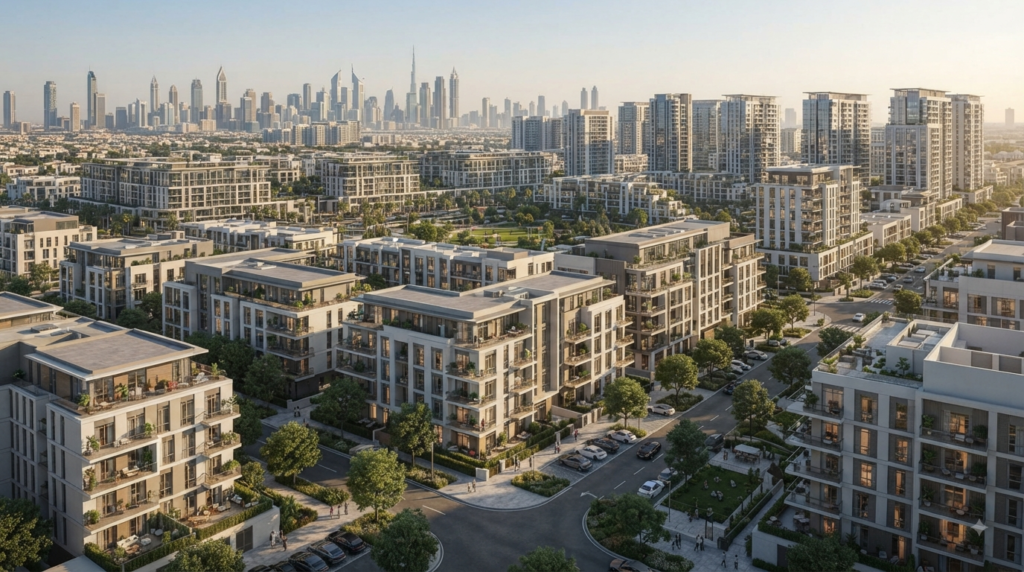
The Gold Coast median house price sits near AUD 1.18 million in 2026, with units near AUD 795,000 and vacancy rates around 1.3%, while rental yields for houses average 2.8% to 4.1%. These are the baseline numbers every Gold Coast investor must hold in mind when evaluating the average house price in Dubai comparatively.
Entry Price Gap
The most immediately striking difference between the two markets is the minimum capital required to access quality investment stock. A Gold Coast investment-grade unit requires approximately AUD 795,000 to AUD 987,000 at current prices. A comparable Dubai investment apartment in JVC or Dubai South requires approximately AUD 294,000 to AUD 378,000.
That is not a marginal difference. It represents a 60% to 70% reduction in required entry capital for a similar or superior income asset. Gold Coast investors can purchase two Dubai investment apartments for less than the cost of a single comparable Gold Coast unit.
Yield Comparison
The yield gap between the two markets is equally significant. Gross yields for Gold Coast units sit around 5.3%, compared to roughly 4.1% for houses, according to Cotality (formerly CoreLogic) data. After Queensland land tax and management fees, net yields for many multi-property Gold Coast investors fall below 3%.
Dubai mid-market precincts deliver gross yields of 6% to 12%. After Dubai property management fees of 5% to 8% and zero land tax, net yields remain 5% to 9% in established precincts. For full rental yield data by Dubai precinct, read Property for Rent in Dubai: Gold Coast Investor Yield Guide 2026.
Growth and Returns
| Market Metric | Gold Coast 2026 | Dubai 2026 |
| Median House Price | AUD 1.17M to 1.35M | AED 1.55M (AUD 651K) |
| Entry Price (Apartments) | AUD 795,000+ | AUD 294,000+ |
| Gross Rental Yield (Houses) | 2.8% to 4.1% | 6% to 12% |
| Annual Land/Property Tax | Yes (Queensland) | Zero |
| Council Rates | Yes | No equivalent |
| Price Growth (YoY) | 10% to 12% | 90% over 6 years |
| Vacancy Rate | 1.1% to 1.3% | Below 5% (prime zones) |
The full picture favours Dubai on yield, entry price efficiency, and holding cost structure. The Gold Coast retains advantages in proximity, local market familiarity, and AUD-denominated returns. Both considerations matter to a well-structured investor portfolio. For the complete financial and SMSF comparison, read Buy Property in Dubai from Australia: The Complete 2026 Finance Guide.
Why Invest in Dubai?
Understanding the average house price in Dubai is only part of the picture. The structural reasons why that price point delivers superior returns to Gold Coast investors in 2026 come down to three factors that reinforce each other.
Tax-Free Ownership
Dubai charges zero annual property tax, zero rental income tax, and zero capital gains tax on property held within the UAE. There is no land tax equivalent, no council rates, and no municipal levy beyond a building service charge.
Gold Coast investors currently paying Queensland land tax on accumulated portfolio value understand exactly how much this structural difference matters to net returns. Every percentage point of gross yield in Dubai is retained at a meaningfully higher rate than its Gold Coast equivalent after tax.
Australian tax obligations still apply. All Dubai rental income must be declared to the ATO at your marginal rate, and capital gains on sale are subject to Australian CGT rules. But the absence of UAE-side taxation means the gross-to-net yield conversion in Dubai is far more efficient than any alternative offshore market where investors face dual taxation.
Payment Plan Benefits
Most Dubai off-plan developers offer interest-free staged payment plans requiring only 10% to 20% upfront. On a AUD 378,000 JVC one-bedroom apartment, the initial outlay is approximately AUD 38,000 to AUD 75,600, with the remainder spread across construction milestones over 12 to 36 months.
Key payment plan structures available in 2026 include:
- 10% reservation deposit on booking
- 40% across verified construction milestones (RERA-supervised escrow)
- 50% on handover, or spread post-handover over one to three years
- Post-handover plans available on selected Emaar, DAMAC, and Imtiaz projects
This interest-free structure delivers capital efficiency unavailable in the Gold Coast market. A Gold Coast investor can enter Dubai at 10% down while the remaining capital continues working in domestic assets.
Golden Visa Eligibility
Properties valued at AED 2 million or above (approximately AUD 840,000) qualify for UAE Golden Visa eligibility, granting ten-year renewable UAE residency for the investor, spouse, and dependent children. No local sponsor is required.
For Gold Coast investors at the AED 2 million threshold, two-bedroom apartments in Dubai Marina and Business Bay are the most common qualifying assets. These properties also deliver gross yields of 6% to 8%, making the Golden Visa a residency benefit attached to a genuinely productive investment asset. Read more on Dubai Golden Visa Property: What Gold Coast Investors Need to Know.
Understanding the three structural advantages- zero tax, payment plan efficiency, and Golden Visa eligibility- reframes how Gold Coast investors should evaluate the average house price in Dubai against domestic alternatives. The price comparison is only one dimension of a broader investment case.
How Do You Buy?

The process of buying Dubai property after understanding the average house price in Dubai is straightforward for Gold Coast investors. Every step can be completed remotely from Queensland without visiting the UAE.
Purchase Steps
The purchase process follows a defined sequence once you select a project at the Dubai Property Expo Gold Coast 2026:
- Pay a 5% to 10% reservation deposit via international bank transfer
- Sign the Sales and Purchase Agreement digitally from Queensland
- Pay the 4% Dubai Land Department registration fee at title registration
- Follow the instalment schedule across construction milestones
- Receive Title Deed at handover and appoint a property manager
All off-plan payment funds are held in RERA-supervised escrow accounts and released to developers only at verified construction milestones. This protects Gold Coast investors throughout the construction period.
Cost Breakdown
Beyond the purchase price, Gold Coast investors should budget for these additional costs.
| Cost Item | Rate | AUD Estimate (AUD 378K Purchase) |
| DLD Registration Fee | 4% of purchase price | AUD 15,120 |
| Agency Fee (resale purchases) | 2% of purchase price | AUD 7,560 |
| Currency Transfer Costs | 0.3% to 0.8% via specialist FX | AUD 1,134 to AUD 3,024 |
| Annual Service Charge | AED 10 to AED 30/sq ft | AUD 1,764 to AUD 5,292 |
After helping hundreds of Gold Coast investors enter the Dubai market, the most common feedback is that the process is simpler than anticipated once the right developer and support team are in place.
Remote from Queensland
The entire transaction, from reservation to title deed, can be managed from the Gold Coast without any UAE visit. Contracts are signed digitally, payments are made via international bank transfer, and a Dubai-based property manager handles leasing, maintenance, and monthly income transfers to your Australian bank account.
Property management fees of 5% to 8% of gross annual rental income cover all on-ground operations. For the complete step-by-step remote buying process, read How to Buy Property in Dubai from Australia: Step-by-Step Guide (2026).
The remote buying model is well-established across hundreds of Australian investors who own Dubai property today. It is the normal experience, not the exception. Knowing the full cost picture and process before attending the expo ensures Gold Coast investors arrive prepared to move on the right opportunity on the day.
Start Investing from Gold Coast
The average house price in Dubai offers Gold Coast investors an entry point that the domestic market cannot match in 2026. Studios from AUD 294,000, one-bedroom apartments from AUD 378,000, zero local property tax, and gross yields of 6% to 12% combine into a financial case that compounds significantly over a multi-year hold.
The Dubai Property Expo Gold Coast 2026 is your most efficient access point. Every project is pre-vetted, RERA-registered, and presented by developers with confirmed escrow protection and track records of on-time delivery.
Registration is completely free, and seats are limited. Secure your place at the Dubai Property Expo Gold Coast 2026 today.
Frequently Asked Questions
What is the average house price in Dubai in 2026?
The estimated average housing price in the Dubai residential market in 2026 is approximately AED 3.05 million (around AUD 1.28 million), while the median sits closer to AED 1.55 million (AUD 651,000). For investment-grade apartments, which are the most relevant entry point for Gold Coast investors, studio and one-bedroom prices start from AED 700,000 (AUD 294,000) in mid-market precincts like JVC and Dubai South.
How does the average house price in Dubai compare to the Gold Coast?
The Gold Coast median house price sits near AUD 1.18 million in 2026, with units near AUD 795,000, while comparable Dubai investment apartments start from AUD 294,000 in high-yield precincts. The average house price in Dubai across investment-grade stock is 50% to 70% below Gold Coast equivalents, with gross rental yields two to three times higher.
Is Dubai property cheaper than Gold Coast property?
At the investment apartment level, yes, Dubai is significantly cheaper than the Gold Coast. Entry-level investment studios in Dubai start from approximately AUD 294,000 compared to a Gold Coast unit median of AUD 795,000 in early 2026. Premium Dubai precincts like Palm Jumeirah and Downtown Dubai match or exceed Gold Coast luxury price points.
What rental yield can Gold Coast investors expect?
Dubai mid-market precincts like JVC and Dubai South deliver gross rental yields of 7% to 12%, compared to the Gold Coast house average of 2.8% to 4.1% according to CoreLogic. After Dubai management fees and zero land tax, net yields typically range from 5% to 9%, well above comparable Gold Coast net returns.
Are Dubai property prices still rising in 2026?
Dubai’s average price per square foot has risen approximately 90% from AED 872 in 2020 to AED 1,658 to 1,916 in 2026, reflecting sustained demand from population growth and limited freehold supply. According to Knight Frank, Dubai remains one of the world’s top-performing residential markets with price growth projected to continue through the mid-decade period.